Prevent payment fraud. Detect threats early. Prove you can recover
Most SMEs are not under-protected — they are under-prepared.
Missing or corrupted backups leave organizations unable to restore critical data after incidents..
Delayed detection allows breaches to escalate before containment measures are activated.
Insufficient documentation weakens insurance claims, audit compliance, and regulatory adherence.
Enjoy quick and reliable shipping with secure packaging, bringing your favorite beauty essentials.
Security weaknesses or disruptions at software providers, cloud services and other suppliers can expose your systems, data and operations.
Outdated software and unresolved vulnerabilities give attackers known weaknesses they can exploit to access sensitive data and disrupt business operations.
One Resilience approach.
Accountable decisions and action
Faster detection and response
Protection across your business
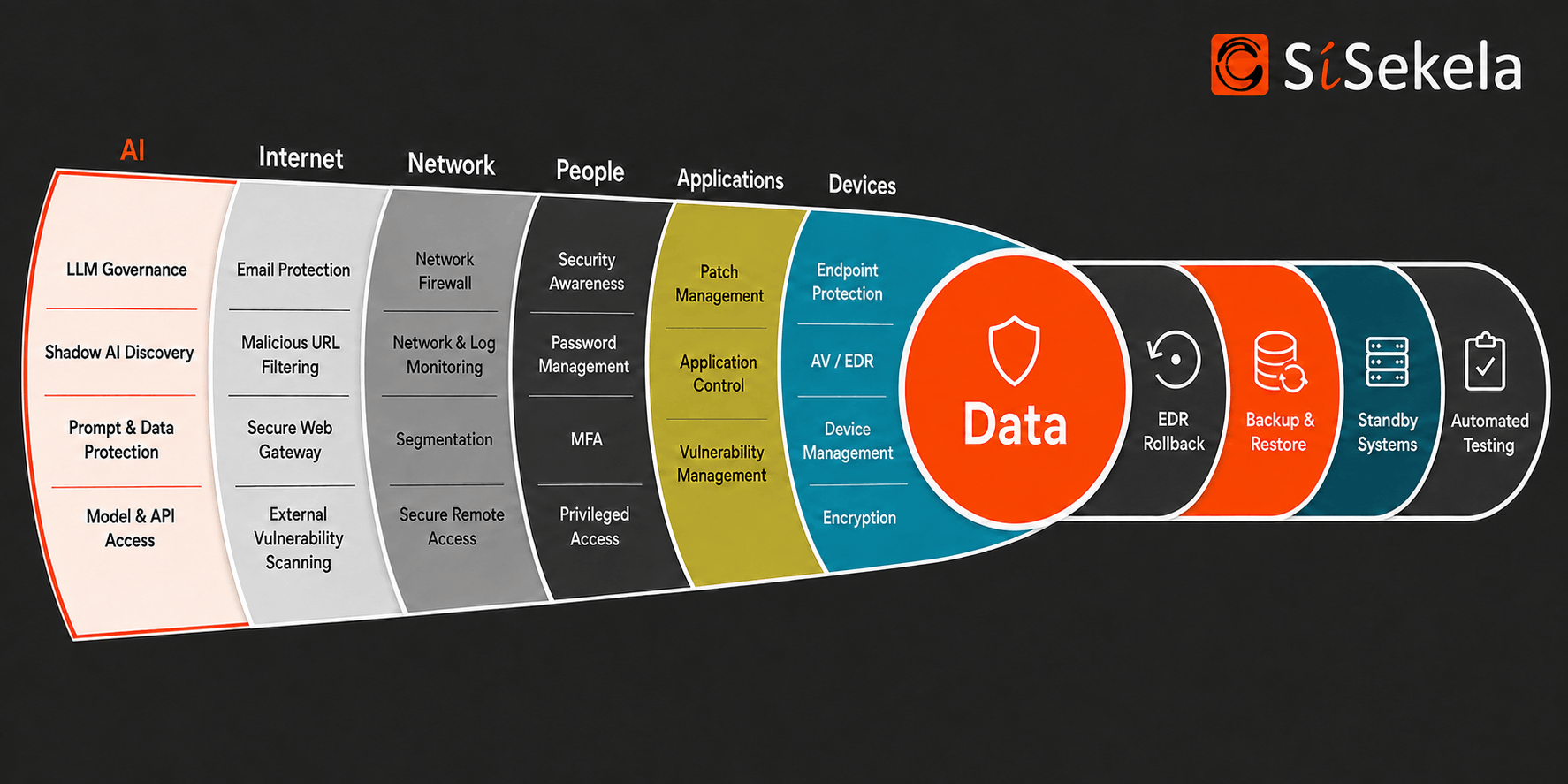
We help businesses manage cyber risk and strengthen resilience before, during and after an incident. Our combination of human expertise, specialist security operations and layered cybersecurity controls helps prevent payment fraud, detect threats earlier, respond faster and prove recovery—while complementing and strengthening your existing IT team.
Reduce risk. Strengthen readiness.
*Strengthen email, identity, device and data protection.
*Identify vulnerabilities and control gaps before they are exploited.
*Reduce exposure to payment fraud and business interruption.
*Clarify responsibilities and verify recovery readiness.
Detect early. Contain quickly.
*Monitor for suspicious activity and genuine threats.
*Investigate alerts before disruption spreads.
*Contain threats through a defined response process.
*Give leadership clear information for accountable decisions.
Restore operations. Prove recovery.
*Restore critical systems, services and business data.
*Validate recoverability—not only successful backups.
*Preserve evidence and document what happened.
*Address weaknesses and strengthen controls against future incidents.
Stronger safeguards, fewer preventable incidents and clear evidence that your business is prepared.
A faster, controlled response that reduces operational and financial impact.
Recovery assurance, business continuity and stronger long-term resilience.
Our Essential, Advanced, and Resilience packages provide increasing levels of protection, monitoring, response, and recovery assurance. You do not need to select a complete package—we can assess your existing IT environment, identify the gaps, and provide only the individual cybersecurity services your business requires.
Choosing a cyber-resilience partner deserves proper scrutiny. We encourage businesses to question cost, overlap, responsibility and proof before making a decision. Here are some questions we are regularly asked—and our straightforward answers.
That is usually the right starting point. SiSekela does not replace your existing IT team. We add specialist monitoring, incident-response support, recovery assurance and cybersecurity evidence where gaps exist. Responsibilities are agreed upfront, so your IT team retains ownership of the environment.
Antivirus and firewalls are important, but they are only part of the protection your business needs. Traditional antivirus primarily recognises known threats it has been programmed to identify, while new threats and attack methods emerge continuously. Layered cybersecurity adds email and identity protection, behavioural detection, active monitoring and human response to identify and contain suspicious activity that traditional controls may miss.
Backup and disaster recovery are not the same thing. A backup usually protects copies of your data. Disaster recovery focuses on restoring your complete operating environment—including systems, applications, configurations and access—so the business can function again. A successful backup does not prove that everything can be recovered and brought back online; that requires a documented and tested recovery process.
That is positive, but many cyberattacks are automated and target exposed accounts, weak email controls and untested recovery rather than a particular business size. The important question is how dependent your business is on email, payments, systems and data—and what would happen if they became unavailable.